I designed a Kubernetes course instead of taking one. (Yes, with AI)
Contents
TL;DR: I created, with Claude, a custom, 100% practical Kubernetes learning track to follow along that teaches the concepts from the ground up. A few lessons of etcd, the API Server, PKI for K8s, etc. even before touching kubectl.
The rest of this post is not about Kubernetes, and it’s an intro and background of this learning track. It’s a bit philosophical, and my personal experience about the process. The “How to do this” is very straightforward.
You can visit the course and follow along here (No dark mode, sorry for the flashbang): https://argandov.github.io/kubernetes-by-hand/,
Read directly on Github: https://github.com/argandov/kubernetes-by-hand,
Or clone the repo and read locally:
git clone https://github.com/Argandov/kubernetes-by-hand.git
Of course, any feedback you may have about the “track” is welcomed! I would love to read your comments on this one.
Why I did this (And how)
I’ve hit a wall every time I’ve tried to learn Kubernetes throughout the years: With traditional methods, I’ve found Information becomes a perplexing word soup pretty fast, and I eventually end up confused and forgetting things. For example, I don’t really enjoy watching courses (It kind of invites passivity and making me feel like I learned when in reality I didn’t), and reading the official documentation is a challenge for me because it makes a lot of assumptions about the reader.
Unfortunately, I have quit a couple of times. What I want is NOT to brute force my way in and memorize terms and commands, but to REALLY understand Kubernetes and its inner workings so commands and the stack, “just make sense” intuitively and I don’t need to memorize anything.
With this goal in mind, I also hit the next wall: How to actually learn it the way I want?
My custom workflow
I established my background, context, purpose, goals, preferences, etc. in a Claude project so it could generate Markdown content based on that context.
I already have Docker, Linux, networking, etc. experience, so I co-created this “track” with the depth I want, tailor-made to my current knowledge and my way of learning.
It generates this content in batches of 2 “parts” each, and it was a deliberate decision, so I can course correct as I finish the last part, have any feedback for Claude, want to do improvements, etc. before it generates the next “batch”. The only issues I’ve had, are out of date instructions.
For example, I wanted to make one of the first lessons on the API server, pure HTTP based, in order to focus on the mechanisms involved and leave RBAC and TLS encryption to a dedicated chapter, but it didn’t work since TLS is mandatory for the API server nowadays, so I needed to correct course. I introduced PKI in session 2.5.
I also introduced a few learning tools/methods that work for me when I study written content:
- Priming questions: Questions at the beginning that the reader shouldn’t be able to answer yet, but are very important, can be guessed or even intuited at the start, and “prime” our brain for receptivity. This way, introducing interesting things or issues so our brains “fill in the blanks” as we go through the actual content.
- “Verification gates:” At the end of each chapter, a bullet list of “things the reader should be able to do by him/herself by now”.
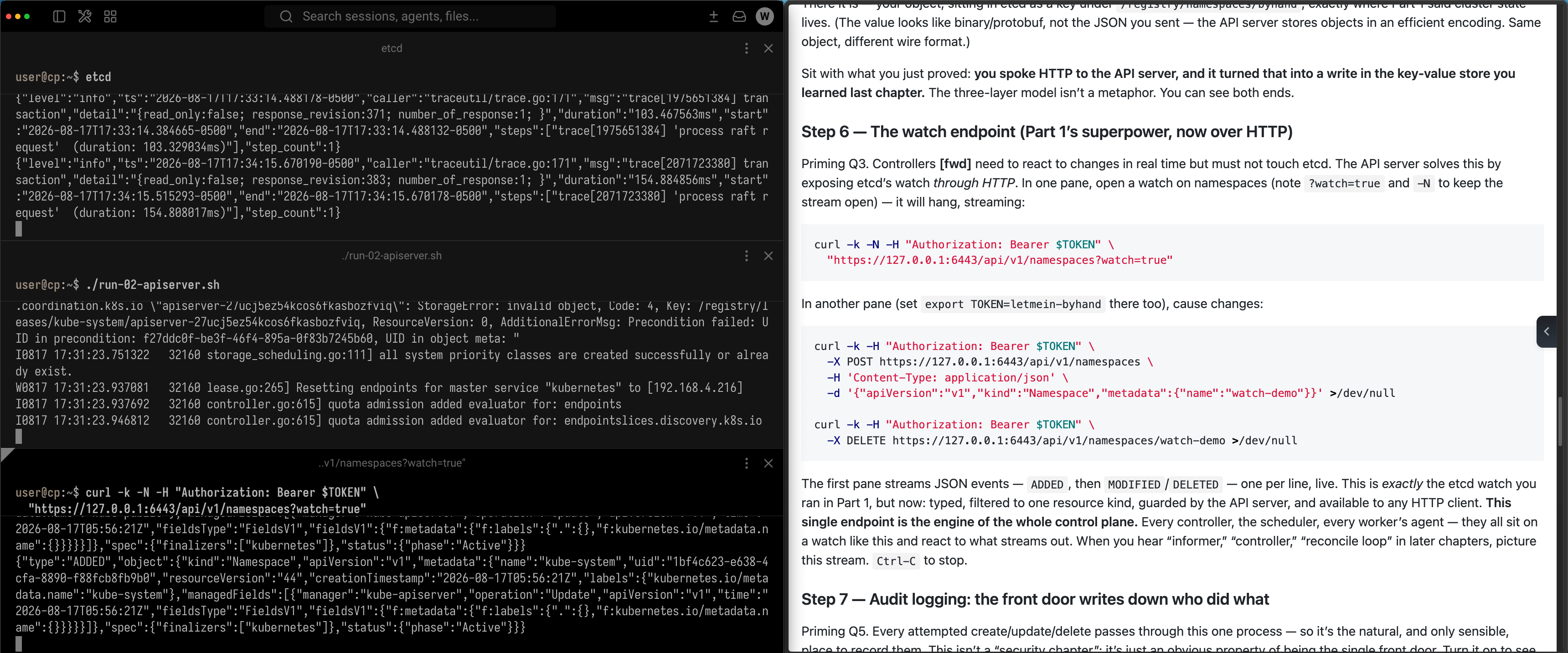
Of course, it’s 100% practical, and to be consumed side-by-side with 1 or more SSH sessions open:
Conclusion
At first, I took for granted what I just made, but then realized this is deeper than “I asked Claude to explain pods”. To me, this is what the future of education might be like: Using AI to learn things, as an adaptive tutor (Which I find very interesting), by really creating custom, follow-along courses. Mine was just an afternoon of giving enough context, background, goals, format, etc.
As I go through my own k8s course, I can’t get more excited; it’s exactly the way I wanted to learn it: from the ground up, learning and applying first principles. I am not only understanding underlying systems and how they work together, but also feel very engaged with the content.